

My Favourite Project (18): Alessandra Armenise
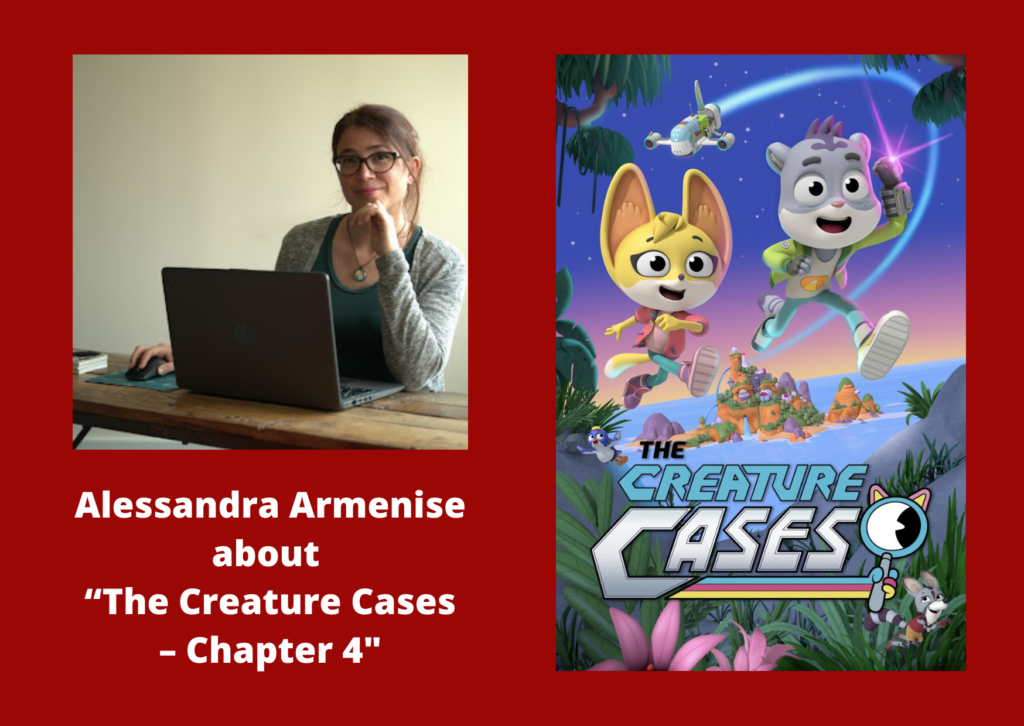
We often speak about how much knowledge and skills are required to work in audiovisual translation and how much effort and care we bring into our projects – but we rarely talk about the details of the process itself. At SUBTLE, we decided to change that, and give the world a peek behind the curtain.
We invited our members to tell a little bit about a project of their choice – one of the most memorable, challenging, exciting things they had a chance to work on, and what exactly made it so.
The 18th instalment of “My Favourite Project” comes from Alessandra Armenise, English, French and Portuguese to Italian translator and subtitler, who writes about her experience translating “The Creature Cases – Chapter 4“. Enjoy!
The Creature Cases – Chapter 4 was my first subtitling project for a young audience, and I was delighted to discover all the different challenges hidden in what may appear as a simple cartoon.
The Creature Cases is an educational yet fun series, following the detectives Kit (a kit fox) and Sam (a snow leopard), in their quests to resolve mysterious events in the animal world.
Although the relationship between the animals is fictional, the mysteries are based on the real behaviours and difficulties of some very specific species around the world. Every episode ends with an informative song about the animal at the centre of the mystery.
The first challenge was the drastically lower reading speed required for children’s programs (my target reading speed was 13 characters per second with a maximum reading speed allowed of 17 characters per second). We know we should aim to achieve lower reading speed for any content, but it’s a different story if it can’t be exceeded even when you really need to. This being my first time working on children’s content, I was shocked realising that nothing was fitting in, and I had to rephrase and sometimes severely trim and merge, to achieve a reading speed that was acceptable for a younger audience.
The second challenge was translating the animal and plant species’ names.
I discovered that some species have a common name in English but only a scientific name in Italian, and that others are not known at all in Italy.
In some cases, the scientific name was telling enough and could be used instead of a common name: for example, the “stinking passionflower” is only known as Passiflora foetida in Italian. Since “fetido” is an adjective meaning “horribly stinking,” I used the Latin name in my translation.
However, in many other cases, such a solution wouldn’t have worked, so I had to invent some common names! Who knows, maybe the future Italian generation will know these animals by the names they read in The Creature Cases’ subtitles! (I am joking, but I did feel the responsibility!) A couple of examples of this issue were the “skunk frog,” only known as Aromobates nocturnus, which became “rana puzzola” and the “yellow garden spider,” only known as Argiope aurantia, which became “ragno giallo da giardino.”
The third challenge was the number of puns! At least one or two in each episode, they made me go pale, and then dive into my notebook, scribbling options, words, and ideas until I found something I was happy with.
And I will leave you with one of them, because I know you are curious minds.
In one episode, the detectives are trying to discover what animal is eating the birds’ eggs, and the main suspect is an old tuatara, with blunt and missing teeth. (You don’t know what a tuatara is? As I said, the species are very… specific!)
Anyway, the detectives ask each other:
“Is he telling the tooth? Ehm… The truth?”
Luckily, the Italian language came to the rescue, and I translated it as:
“Dice la verità o dente? Ehm… Mente?”
I don’t know about you, but I would have never thought my brain would have to work so hard to translate a preschool children’s show, and it was so fun and stimulating to stand corrected.
See The Creature Cases in SubtleBase
See Alessandra’s profile in SUBTLE Members’ Directory