

My Favourite Project (8): Joanna Gołąb
We often speak about how much knowledge and skills are required to work in audiovisual translation and how much effort and care we bring into our projects – but we rarely talk about the details of the process itself. At SUBTLE, we decided to change that, and give the world a peek behind the curtain.
We invited our members to tell a little bit about a project of their choice – one of the most memorable, challenging, exciting things they had a chance to work on, and what exactly made it so.
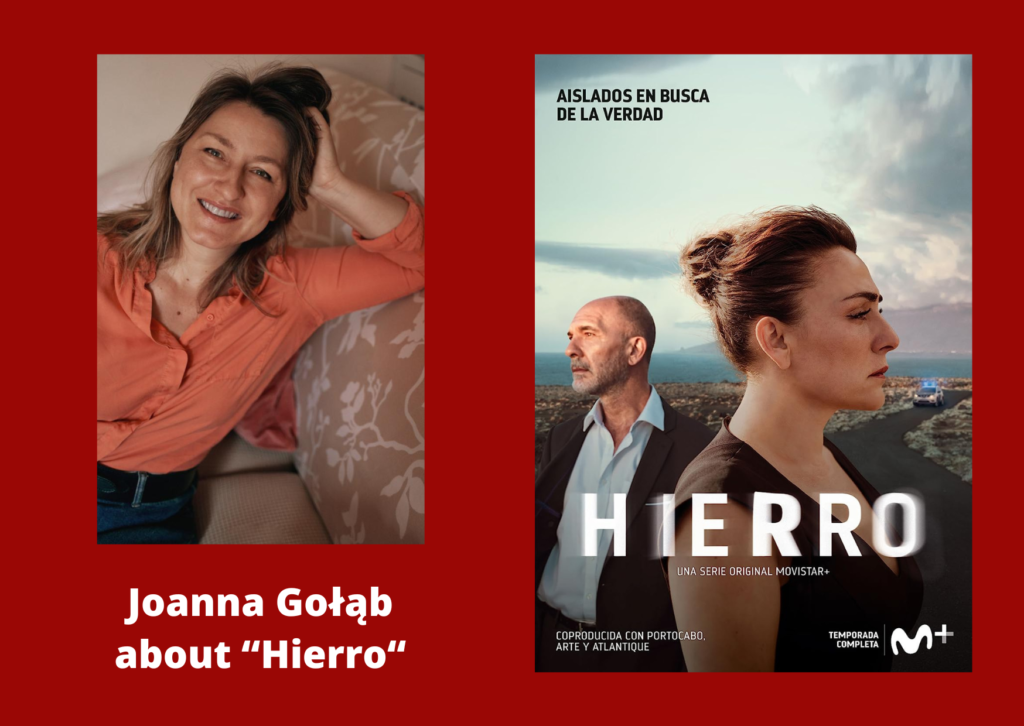
The eighth instalment of “My favourite project” comes from Joanna Gołąb, Polish translator and subtitler, who talks about her work on subtitling “Hierro”. Enjoy!
Much like the boy from Cinema Paradiso, I used to watch films sitting in my dad’s projectionist booth. There I was, enthralled, motionless, open-mouthed, just like Totò. The place was Poland, though, and I was not witnessing the heyday of Hollywood glamour. Instead, I was being exposed to a perplexing mixture of lingering Soviet propaganda films – which still preceded all screenings – and the big 1980s American productions that were beginning to percolate into the nondescript Podkarpacie, then a region in desperate need of a cultural redefinition.
Those childhood years spent assimilating the works of Spielberg, Cameron, Scorsese or Frears (some of which I should not have seen, but got to see thanks to my dad’s flippant attitude to age restrictions) allowed me not only to learn English without ever having to study it, but also find a vocation. This passion for film has stayed with me during my university days and became reactivated when I moved to Spain 9 years ago, translation diploma in hand. Anyway, to the point…
“Era un machango. Cojonudo pero un machango”. I had already gone through the first episode of Hierro, thinking the series might be a pleasantly effortless August job, when I encountered that at the beginning of episode 2. There can be very easy translations to do in the AVT world. Maybe I shouldn’t say that but yes, some films are repetitive, have a fair share of hackneyed phrases, and need to be translated for pure entertainment rather than profound ruminations. Nothing wrong with that. These jobs still require translation insight, tweaking of time codes and understanding of the craft, and can be very satisfying to do. And then you get jobs that make you rack your brains, explore half the Internet and consult all your (Spanish) friends. This little Canarian word, “machango”, a result of improvisation, as explained here by the actors, has loomed large in my mind from the moment I heard it. Was I to introduce the Polish viewers to the quirky word from the Canary Islands, risking they go around the Peninsula calling people “machango”? And should I actually worry about that? After all, the use of Spanish series in language learning should not be something that would inform my decisions, right?
But there was more to come, because Hierro is one of those series that carries a lot of cultural baggage and makes you think twice about every translation choice. At first glance, it is just another police drama, with all the comfortable clichés of the genre – a strong female protagonist with a burdensome past (attractive yet unapproachable, smart yet vulnerable, experienced yet lost in her new surroundings), accompanied by a bevy of police officers, public servants and the like, and desperate to make a presence in the tightly-knit island community. She is a peculiar character, a Spaniard but with a “guiri” air of someone displaced from the secure inland, having to constantly scan the environment for signs of deception, working out the meaning of local pleasantries and words.
So once I got over the “machango” hurdle, I then found references to “la Bajada”, “toque”, “la raya”, not to mention the oh-so-Spanish honorifics, the rather awkward “Señoría” or less problematic “usted”. All of these required a stance, me deciding on how they should be delivered to the Polish viewers. I was helped by the fact that Candela, the main protagonist and judge, is herself a newcomer to El Hierro, the second-smallest Canarian island. Like the Polish viewers, she becomes overwhelmed by the religious fervour surrounding the puzzling “Bajada”, tactlessly dismisses it as a mere “romería”, and has to be explained (in angry Spanish) what the fuss is about. That is tremendous help when subtitling, since all the religious terms are immediately footnoted by the locals. No pressure to squeeze in explanations where the dreaded CPS is a suffocating restriction.
Then there were less obvious challenges, like the constant switching between “usted” and the informal “you”. Luckily, Polish has these dual forms of address, but I needed to stay on my toes, monitoring the fluctuating relationships the judge has with both her colleagues and locals. She is addressed simply as Candela by Ángela, her secretary and reluctant collaborator, who looks to diminish the social distance and ingratiate herself with the new boss. To the rest of her colleagues, Candela is “Señoría”. This is how she is always referred to by the very official Morata and most of the time by Elvira, except when they empty a bottle of white wine, start imitating the sound of the local shearwaters (“pardelas”) and drop the honorifics – something very Spanish and which needs to be retained in translation. She also lets her hair down a bit with a local pizzeria owner, who goes as far as to endearingly call her “cabrona” (“bitch”), an epithet she does not object to too much (try that with a Polish judge!). This and other “insults”, so natural to the Spanish, should not be watered down in translation.
Candela herself is not consistent with how she speaks to the locals, a clear reflection of her confusion about whether she can trust them or not. She always treads lightly, more often than not resorting to “usted” as a safe, default form of address, avoiding overfamiliarity as it might lead to favouritism or to someone going off the radar as a murder suspect. This is clearly seen when she becomes increasingly cordial with Idaira, her son’s sitter, only to retract to a cold, authoritative “usted” when the girl is brought in for questioning, and go back again to a warmer “you” when she is visited by her at the hospital (a change facilitated by a bottle of the Canarian “ronmiel”). Another character she is ambivalent about is the main suspect, Díaz, to her too obvious a choice as the guilty party, and to the majority of the islanders – a perfect scapegoat. In a moment of weakness, she is consoled by him, and the appellation “Señoría” becomes temporarily redundant.
Much has been written about the detailed depiction of the island in the series, and El País has come to compare it to other works inviting post-production tourism, such as The Wire (Baltimore), Peaky Blinders (Birmingham) or Treme (New Orleans). It was even more important, then, to preserve the language elements that complete the picture. This linguistic expedition sparked my interest in translating from Spanish, my local language for nearly a decade. I have gone on to work on the high-profile Élite and the rather low-key Josefina and La Hija de un Ladrón, both shown at a festival of independent cinema with an intimate Cinema Paradiso feel. I am grateful that I can work on both small and big productions, and get to choose where I take my linguistic explorations next. In a lot of ways, I am still like Totò – and want to stay like him.