

My Favourite Project (10): Jason Franzman
We often speak about how much knowledge and skills are required to work in audiovisual translation and how much effort and care we bring into our projects – but we rarely talk about the details of the process itself. At SUBTLE, we decided to change that, and give the world a peek behind the curtain.
We invited our members to tell a little bit about a project of their choice – one of the most memorable, challenging, exciting things they had a chance to work on, and what exactly made it so.
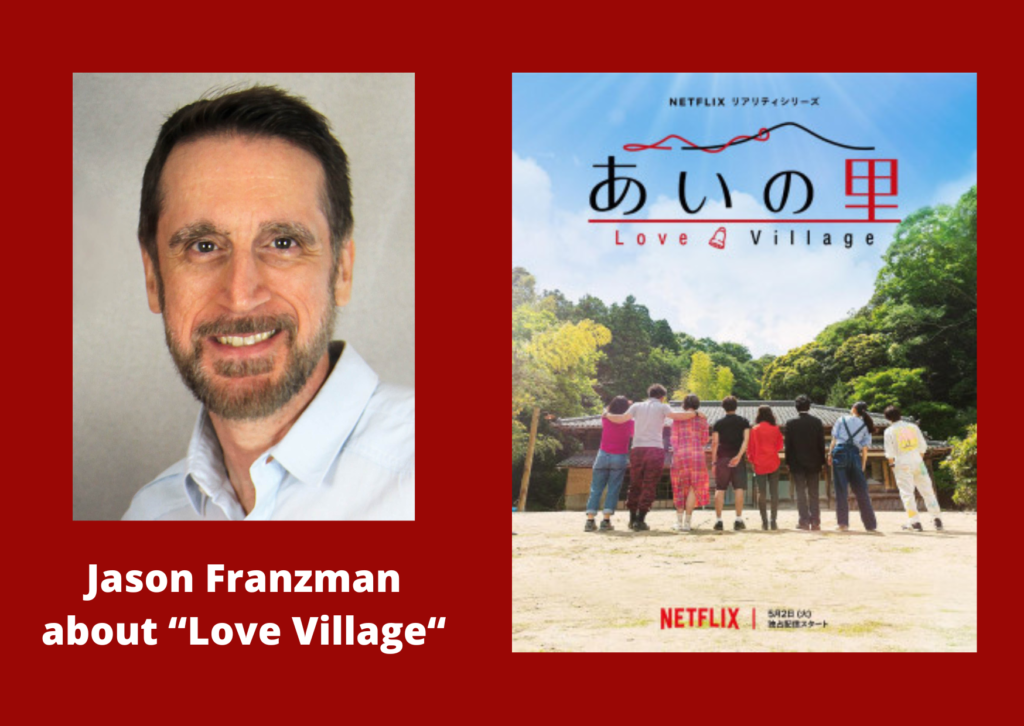
The tenth instalment of “My Favourite Project” comes from Jason Franzman, a Japanese-to-English audiovisual translator, who talks about his work on subtitling “Love Village”. Enjoy!
A Romance Reality Series?!
Yeah, I know. Reality shows are not exactly highbrow material, especially romance reality series. It may seem strange to pick Love Village as my favorite project, but hopefully, my reasons for doing so will be clear by the end of this article!
I actually struggled with whether to write about other projects I loved, such as Call Me Chihiro, a bittersweet film about a wandering soul, or Season 1 of Shadows House, a creepy-cute gothic anime about brainwashed servants who think they are automatonic dolls. While I absolutely adored both projects, they weren’t overly challenging, so there wasn’t much to write about.
Still, it’s not that I didn’t like Love Village. I actually enjoyed it. But it was the most challenging subtitling project I’ve ever completed, mainly due to the chatty nature of the show and the 500+ subtitle events crammed into every approximately 30-minute episode.
So What Is Love Village?
Love Village is a Japanese romance reality show for, shall we say, “leveled-up” grown-ups, mostly in their mid-to-late 40s but as young as 35 and some up to 60. The show’s premise is “Finding the final love of their life.”
In the show, four women and four men relocate to a charming, rustic Japanese-style house in the middle of nowhere. They must cook and do chores together while managing a meager monthly food budget. No phones or computers allowed! As bonds are formed and love blossoms, cast members can ring the Love Bell and profess their love for a fellow housemate. If a match is made, the happy couple leaves the show together and is replaced by two new cast members. If not, the rejected party must leave and be replaced by someone new.
Challenges Galore!
The first and foremost challenge was the spotting. The show had a large cast, a narrator, a camera crew that asked the cast questions, two celebrity hosts (Becky and Atsushi Tamura) who are well-loved in Japan, and frequent bits of onscreen text. Not only that, the dialogue from the various sources was often overlapping, sometimes even three or more speakers simultaneously, so it was a challenge to figure out what to retain and how to make it fit. Thank the stars for dual-speaker subtitles. I’ve never used so many in my career!
I received instructions early on that I should try to fit the celebrity hosts’ running commentary into the subtitles whenever possible, especially when they said something insightful or funny. And funny they were! They had a blast poking fun at the character flaws and idiosyncrasies of the more interesting cast members. Such guidance made my job a little easier, as I knew what the client wanted me to focus on. But it was still a challenge to fit everything in!
The next challenge was the convoluted, vague, choppy, and sometimes downright confusing dialogue, especially when compared to a scripted series. And since the source language was Japanese, it only upped the challenge factor because Japanese often omits the sentence subject and sometimes the verb object—and at times, even both simultaneously! In such cases, one must rely on context and common sense to try to ferret out the meaning.
I must also mention that along with translating and spotting the audio, I was also authoring a pivot template that other translators would use to translate subtitles into their native languages. Authoring a template means writing lots of annotations, and since Japan is so far removed linguistically and culturally from most other countries, a lot of annotations were required!
On top of that, I always aim to write idiomatically natural English in the style I like to read, so that meant I had to make tons of annotations to give the other translators literal and back translations in case their languages have phrases and grammar similar to the source. As such, each episode averaging about 500 subtitles over about 30 runtime minutes ended up with around 200 annotations! I still feel worn out just thinking about it…
Falling in Love (with the Show)
There were two things that made this project special to me. First, the casting was spot on, both the house members and the hosts. They were all funny, engaging, and always entertaining. I laughed out loud many times during the project and even shed a few tears during the more touching moments.
As I mentioned, the show’s premise was “Finding the final love of their life,” and I found that to be so beautiful. I must be getting old and sentimental because it brought tears to my eyes more than once. Being happily married myself, I know I’d feel lost and lonely without my better half! Not that there’s anything wrong with being single. I just think some people are happier in a long-term relationship. And the fact that these people came on the show to find love must mean they really wanted or needed love in their lives.
The second thing I loved about the project was seeing the stark differences between romance reality shows in Japan and the West. I’ve authored and QCed templates for US English and French (via French-to-English pivot) romance reality shows, and I must say they are nothing like their Japanese counterparts! With Japanese romance reality, there’s much less “look at me!” And you don’t see the pettiness and mean behavior that is a staple in the West. I find the more subtle emotions and self-deprecating humor of the Japanese far more interesting than the over-the-top, let-it-all-out style typical in the West.
I also loved the humor. Each cast member was addressed exclusively by a nickname, some quite funny and clever. Luckily, I could simply transliterate them, which made my job a little easier. My favorite character received the nickname Anchovy because he was an Italian chef and restaurant owner. He was a kind soul and very hardworking, but he had the strange habit of thinking every female cast member who paid him even a tiny bit of attention was totally into him! The ensuing misunderstandings were a big part of the show’s humor, and the celebrity hosts made good use of it in their commentary. They even created a segment I translated as “Anchovy’s Misunderstanding Playhouse,” which highlighted and poked fun at his many erroneous assumptions.
That’s a Wrap!
In closing, I hope you could see why I thought this project was so special. While I wouldn’t want to translate reality shows on a regular basis, I did fall in love with this one. I’m really glad I had a chance to work on it. And I recently heard Season 2 has been green-lit! Maybe I’ll be lucky enough to snag that project, too!
See Love Village in SubtleBase
See Jason’s profile in SUBTLE Members’ Directory