

My Favourite Project (13): Andrii Kyselov
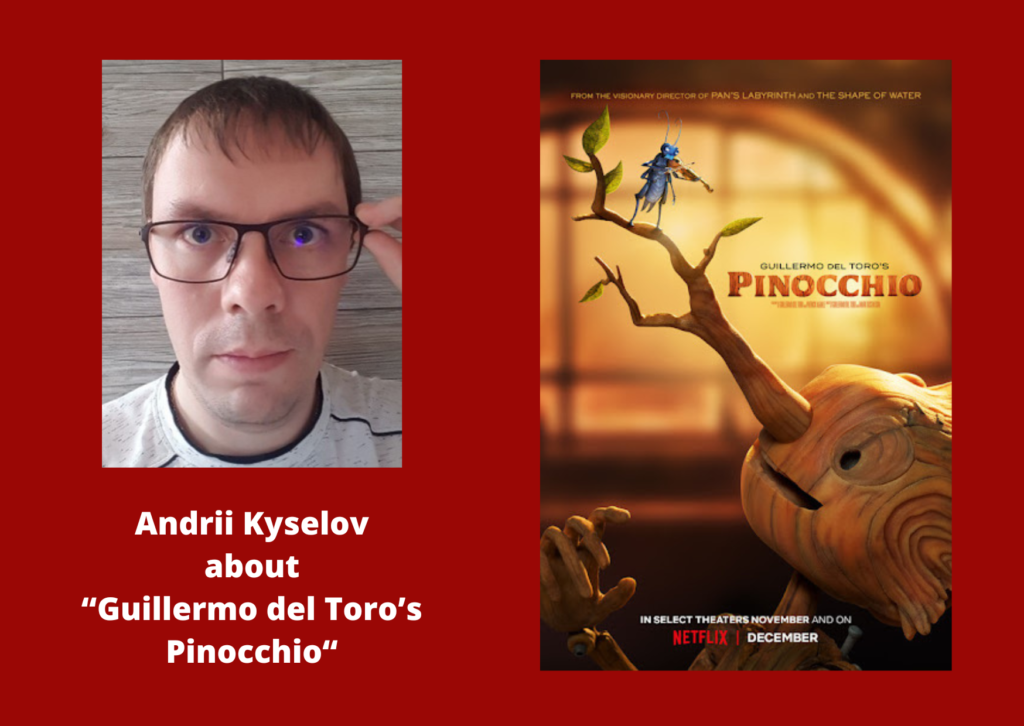
We often speak about how much knowledge and skills are required to work in audiovisual translation and how much effort and care we bring into our projects – but we rarely talk about the details of the process itself. At SUBTLE, we decided to change that, and give the world a peek behind the curtain.
We invited our members to tell a little bit about a project of their choice – one of the most memorable, challenging, exciting things they had a chance to work on, and what exactly made it so.
The 13th instalment of “My Favourite Project” is a special one. It comes from Andrii Kyselov, a Ukrainian/Russian subtitler, who writes about his experience translating “Guillermo del Toro’s Pinocchio” under missile attacks. Please read this emotional, powerful account of the intersection of life circumstances and creative work.
Have you ever heard a cruise missile flying over your head?
One of the less obvious truths about creative arts is that knowing the artist’s time and life circumstances surrounding the creation of a certain work of art is almost inevitably a prerequisite to understanding the real value, or the full magnitude, or the true meaning of it. It is the historical context that makes The Black Square an iconic painting rather than its pure art qualities. The Show Must Go On sounds twice as powerful when you know it is sung through pain by a terminally ill person. And The Lord of the Rings reveals itself from a whole new angle when you know it was born as an effort by a survivor of the Somme to get over the horrors of the Great War.
Now that I think of it, we, subtitle authors, are deprived of the other authors’ inherent privilege to entwine into their creations the hidden meanings, undertones, and allusions that would otherwise give a thoughtful viewer an insight into what the subtitler was living through while creating the respective subs. The nuances are already there, and our mastery is to preserve as many of them as possible to convey the director’s message, not our own.
And yet, when I am thinking of my most memorable project, I can’t help getting back to that one time when translating the subs felt exactly like writing my own story.
Have you ever heard a cruise missile flying over your head? For the first time in my life, I heard that hissing jet-like noise while working on Guillermo del Toro’s Pinocchio. It was October 2022, roughly eight months into the war and two weeks since the massive missile strikes had started to gradually plunge my country into the cold and darkness, when I, an ethnic Russian who had happily lived his whole life in Ukraine, embarked on an eerie and transforming quest to create the Russian subs for this spellbinding masterpiece.
How do you describe what it feels like to translate a poignant anti-war manifest amidst a war? Imagine a rented house a thousand kilometers away from your sweet home. Imagine a dark room in it, only illuminated by the dim glow of your laptop’s screen set to power saving mode so it can last four hours instead of two – blackout or not, you need to work to pay for the rented house a thousand kilometers away from air strikes and artillery barrages. Imagine your ten-year-old son laughing carelessly from the next room – his Minecraft adventure is in full swing, although his gaming laptop, the only precious thing that’s his in this house, is way more powerful than yours and will only last for half an hour unplugged. Imagine suddenly hearing a rapidly approaching hissing noise, as if a low-flying jet is going kamikaze right at you. Your blood runs cold for a few seconds before the noise reaches its pinnacle somewhere above your head and starts trailing away into the distance – this missile was not meant for you. The careless laughter breaks off, your son peeps out from the dark room only lit by the glow of his laptop screen and asks what that sound was. “What sound?” you say as nonchalantly as you can. “Haven’t heard anything.” Your son shrugs and disappears back into the room – his laptop can die any minute now, so no time to waste. With trembling fingers, you press your “next event” hotkey and jump to the first subtitle.
“By the time master Geppetto made Pinocchio, he had already lost a son…”
Wait, it just can’t be…
“Geppetto lost Carlo during the Great War. They had been together only ten years…”
Careless laughter from the next room. A distant explosion of the missile.
In all my years as a subtitler, I have always been okay with the idea that my personal feelings, emotions, struggle, pains, and qualms will not (and one might fairly argue should not) get through to the viewer. As I said, our mastery is in being able to convey the film creator’s message, to almost smuggle it out at times through the bottleneck of all the guidelines, restrictions, limitations, and blockers. However, that October was the only time that I wished the viewer would have known what it felt like to translate those opening lines with my son sitting in the next room. What it took to diligently rhyme the wistful lyrics of Ciao, Papa, knowing how many fathers were losing their lives day after day. How much fear, love, effort, and pain was put into those subtitles. Maybe it would add a new angle to Mr. Del Toro’s amazing story. Maybe it would reinforce his message, powerful as it is. Maybe it could make someone relate. Maybe not.
My most memorable project? Guillermo del Toro’s Pinocchio. One I wish I remembered for something else.
See Guillermo del Toro’s Pinocchio in SubtleBase
See Andrii’s profile in SUBTLE Members’ Directory
Not sure how to even start commenting on this… Thank you, Andrii for sharing this with the subtiling community. I hope this goes well beyond that because it is so important to share this story. I was at the première of Pinocchio in London and Guillermo got emotional on stage, thinking of his late mother who had just passed and how this story was bonding them… Now we all have one more reason to be emotional about this movie and will definitely watch it with different eyes, thinking of the glow of your laptops and hoping it will soon turn into a glimmer of hope for your country.
Thank you, Rachele ❤
So eloquently and beautifully expressed in flawless English. Thank you for sharing and taking the time to write it. Wishing you and your family all the best.
Thank you, Jacqueline ❤