

My Favourite Project (15): Elaine Scott
We often speak about how much knowledge and skills are required to work in audiovisual translation and how much effort and care we bring into our projects – but we rarely talk about the details of the process itself. At SUBTLE, we decided to change that, and give the world a peek behind the curtain.
We invited our members to tell a little bit about a project of their choice – one of the most memorable, challenging, exciting things they had a chance to work on, and what exactly made it so.
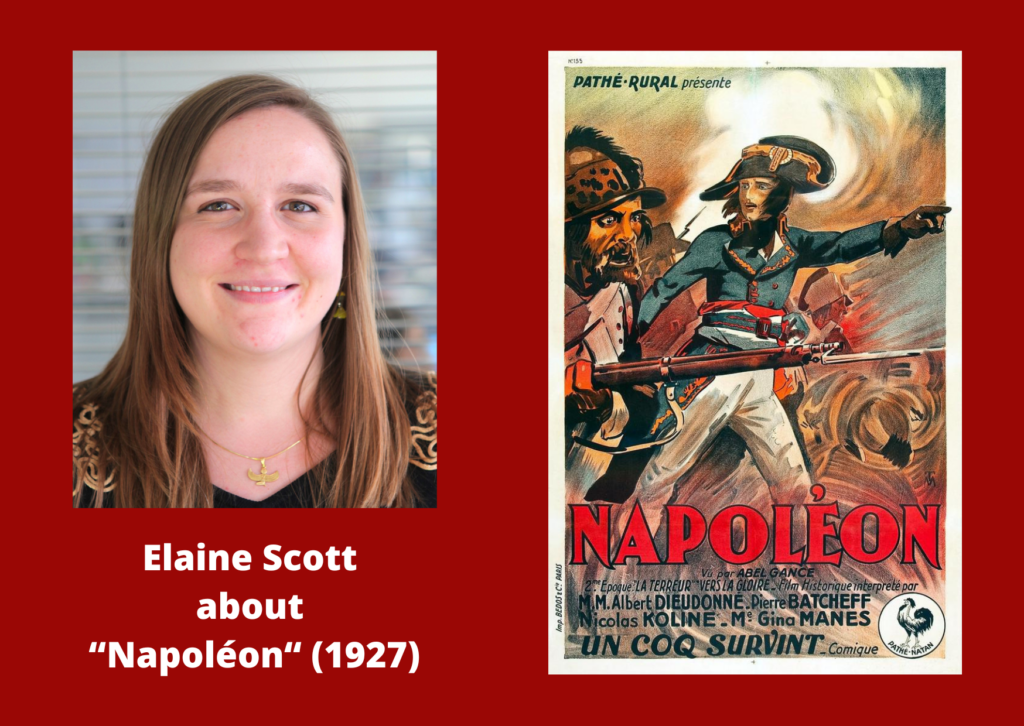
The 15th instalment of “My Favourite Project” comes from Elaine Scott, subtitler working with English and French, who writes about her experience translating “Napoléon”. Enjoy!
A monumental challenge
As a subtitler, diversity is the name of the game. You can be working on a feature-length action film one day and a period drama the next. However, my favourite project is not a recent Hollywood blockbuster or the next bingeworthy series on a streaming platform. This project is like nothing I have ever worked on and I will probably never see the likes again. I am referring to the cinematic titan that is Napoléon by Abel Gance. This epic seven-hour saga, first shown on 7 April 1927 at the Opéra de Paris, has undergone 16 years of careful and dedicated restoration work to return it to its former glory as intended by director Abel Gance.
You may be wondering why a silent movie would be such a challenge to a subtitler, but every guideline or style guide I have ever read needed to be thrown out the window. Subtitlers are audiovisual professionals, but when there is no audio, all you are left with is the visual. How do you adapt 100-year-old intertitles for a modern audience while maintaining the film’s historical significance? Where do you place subtitles on a full-screen intertitle card with text from top to bottom? What formatting do you use? There are often more questions than answers…
“Impossible is not French!”
One of the biggest challenges with this project was understanding and translating the sociocultural context. Ask me about British slang words or what “Quoicoubeh” means in French and I can probably give you a pretty good answer, but translating French references from the early 20th century in a film set in the 18th century required a fair amount of research. To my shame, my historical knowledge does not stretch to the political intricacies of the French Revolution nor to the social context in which Napoleon rose through the ranks, but now I have new-found knowledge ranging from the Reign of Terror to the French Republican calendar (a rather poetic calendar based on nature and the changing seasons – I might start telling people I was born in the month of Vendémiaire).
On top of all that, the sheer weight of this monument of French and world cinema – both historic and historical – was quite a daunting prospect, but working on this project was such an eye-opening experience. I let myself get swept up in the theatricality of it all, watching thousands of extras being filmed using innovative techniques in what was an emerging art form: moving images filmed on horseback, superimposition, underwater shots and the famous triptych finale projected on three screens simultaneously. I can only imagine how spectacular it will be to see it on the big screen and set to music when it opens Cannes Classics at the 2024 Cannes Film Festival. Although I won’t be anywhere near the glitz and glamour of those famous red stairs, it is a privilege to have been a small part of this mammoth restoration.
This project made me reflect on subtitling as a profession and how versatile you have to be. Yes, we are translators, but we are more than that. We are storytellers, wordsmiths, lyricists, poets, technical troubleshooters, researchers, guideline followers, schedulers, quality controllers, accountants, administrators… and the list goes on. And yet, we work in the shadows, making sure that viewers are immersed in the experience without ever realising they are reading subtitles. So, here’s to the people who watch the credits until the very end to see that subtitler’s name flash up on the screen after everyone else has left the cinema or has already clicked on “Watch next episode”. We see you. We appreciate you.
See Napoléon in SubtleBase
See Elaine’s profile in SUBTLE Members’ Directory