

My Favourite Project (5): David Buchanan
We often speak about how much knowledge and skills are required to work in audiovisual translation and how much effort and care we bring into our projects – but we rarely talk about the details of the process itself. At SUBTLE, we decided to change that, and give the world a peek behind the curtain.
We invited our members to tell a little bit about a project of their choice – one of the most memorable, challenging, exciting things they had a chance to work on, and what exactly made it so.
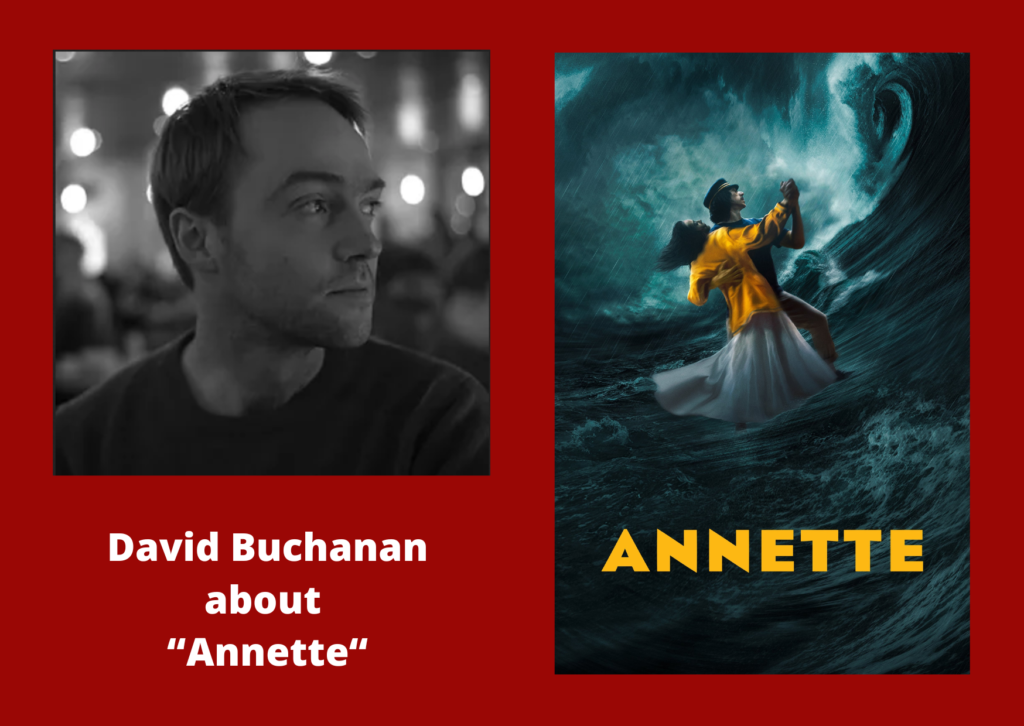
The fifth instalment of “My favourite project” comes from David Buchanan, French to English translator and subtitler, who talks about his work on audio describing “Annette”. Enjoy!
When you say you’re an audiovisual translator, subtitling and dubbing are usually the first things that spring to mind, but many of us also work in the field of audio description (AD). I often take on jobs writing AD scripts, which a voiceover artist will then record on top of a film’s soundtrack so that visually impaired audiences can listen and understand what’s happening on screen.
In some ways, writing AD is quite similar to subtitling and dubbing: all three disciplines involve a puzzle-solving process where you work out what the filmmakers are trying to say, then translate it into another language. The difference with AD, though, is that you translate not the dialogue, but the visuals – facial expressions, physical actions, locations, props, costumes – all of which are woven together into a series of images that a sighted audience can simply watch and absorb. An audio describer’s job is to translate these images into words in a way that’s clear, yet expressive, so that the visually impaired audience can not only follow the action but also get a sense of how it feels.
A couple of years ago, I could hardly believe my luck when I was offered the chance to write the AD for Annette, an operatic movie musical created by two of my favourite artists: the director Leos Carax and the art-pop band Sparks. Carax’s previous film Holy Motors left an indelible mark on me, and I had been a huge Sparks fan for over 15 years, after discovering their classic 1974 album Propaganda. I was thrilled at the opportunity to get to grips with the film, and keen to do it justice.
In many ways, Annette is a mash-up of its authors’ respective styles, and in the course of their careers, both Carax and Sparks have built up devoted cult followings, so it was important that my AD should to try to capture these styles as closely as possible. After all, this “dream-team” collaboration is one of the film’s main selling points. Fortunately, Carax and Sparks have a lot in common: both artists create work that is heightened, even melodramatic at times, but also refuse to take themselves too seriously and regularly undercut the drama with self-aware jokes and postmodern distancing techniques. This mixture of solemnity and irreverence gives Annette a unique, almost hyper-real tone where tragedy and comedy exist side by side. Moreover, because it’s a musical, there is an even greater emphasis on expressivity and emotion. In my attempt to audio-describe this singular tone for a visually impaired audience, I encountered all kinds of interesting cinematic/linguistic translation challenges, and also found a much greater scope for expression than I would have had on a typical project.
For instance, much of the film takes place at night. If I had been working on something realistic like a Dardennes movie, I would simply have described the night in neutral terms, as “the night”. Carax, however, shoots Annette’s nocturnal scenes in such a consistently oppressive, eerie way that the darkness takes on a different quality: it feels endless and all-consuming. So I really enjoyed giving full rein to my melodramatic instincts and describing the night as a “black abyss”; I felt that phrase matched the emotional tone and conjured an appropriate sense of dread.
One of the most interesting puzzles that I had to solve throughout the film was how to describe its use of postmodern distancing techniques. The traditional distancing technique reminds the audience that we’re watching a work of fiction – think Breathless, for instance, when Belmondo turns and talks to the camera. However, Annette uses distancing in a more ambiguous way, blurring the line between real and fake until we’re no longer sure which is which. Actors sing to camera as their real-life selves, then abruptly switch into character; two-dimensional trees on a theatre stage transform into a real live forest; the titular character Annette is played by a marionette, but all the characters treat her as if she’s a real little girl… This ambiguity suffuses the whole film with a dream-like atmosphere where nothing is as it seems and everything is loaded with symbolic meaning. My solution to this challenge was sometimes heavy-handed – for instance, I always had to explicitly state when an actor was in character or not – and at other times it was more subtle, describing the marionette’s movements with onomatopoeic verbs like “wiggle” and “bob” to gently remind the visually impaired audience that this little girl is an inanimate object, even if she’s being treated like a human being.
A third stylistic choice that contributes to Annette’s distinctive tone is Carax’s repeated use of the colour green, usually in connection with the character of Henry McHenry (Adam Driver). Carax’s previous film Holy Motors also makes liberal use of green, so I could safely assume this was a deliberate decision on his part and should therefore play a major role in the AD. Strictly speaking, it was beyond my remit to say why green had been chosen, but if I was going to be consistent in my description of the colour, I had to make an educated guess about the filmmaker’s intentions. As we all know, green is commonly associated with jealousy, and jealousy is also the driving force behind Henry McHenry’s character. So whenever it seemed pertinent, I described any green that appeared – in the form of costumes, props, lighting or locations – especially if it coincided with moments of jealousy. Without wishing to spoil the plot, Henry’s final moment on screen shows how his jealousy has cut him off from everything he loves, so I made sure to describe the green walls surrounding him as his story comes to an end.
These cinematic/linguistic puzzles were made all the more challenging by the fact that many of Annette’s most powerful moments occur right in the middle of musical numbers, when the characters are busy singing. Not only is it bad practice to place AD on top of the actors’ voices; the last thing I wanted to do was interrupt the Sparks’ music and lyrics when they are one of the film’s main selling points. This placed some very tight timing constraints on my AD placement, and when I could find a suitable gap for it, it was often necessary to describe not only what was happening now, but also what had happened thirty seconds earlier, in the middle of the song.
Annette is certainly one of the most creatively demanding projects I’ve worked on, but despite all the timing constraints and translation challenges, the fact that I was already a fan of the artists involved gave me all the motivation I needed, and the fact I had familiarised myself with their distinctive styles made it easier to know what to prioritise in my AD when space was tight. I also really enjoyed the task of capturing Annette’s tone; unlike action, tone is so oblique, so hard to pin down, but it’s also the very thing that makes cinema so magical. I hope that visually impaired audiences are able to sense that tone when they listen to my AD, and to immerse themselves in the strange, haunting world of this singular film.
See David’s profile in SUBTLE Members’ Directory